In 1991, Lynn Margulis coined the term holobiont in a book chapter entitled Symbiogenesis and Symbionticism in Symbiosis as a Source of Evolutionary Innovation: Specation and Morphogenesis (MIT Press).term holobiont is derived from the Ancient Greek ὅλος (hólos, “whole”),[6and the word biont for a unit of living matter.
In September 1994, Richard Jefferson first introduced the term hologenome at a presentation at Cold Spring Harbor Laboratory during a Symposium "A Decade of PCR", published by Cold Spring Harbor Laboratory Press as a video series.7][8 At the CSH Symposium and earlier, the unsettling number and diversity of microbes that were being discovered through the powerful tool of PCR-amplification of 16S ribosomal RNA genes was exciting, but confusing interpretations in diverse studies. A number of speakers referred to microbial contributions to mammalian or plant DNA samples as 'contamination'. In his lecture, Jefferson argued that these were likely not contamination, but rather essential components of the samples that reflected the actual genetic composition of the organism being studied, and that the logic of the organism's performance and capabilities would be embedded only in the hologenome. Observations on the ubiquity of microbes in plant and soil samples as well as laboratory work on molecular genetics of vertebrate-associated microbial enzymes informed this assertion (citations needed).
In 2008, Eugene Rosenberg and Ilana Zilber-Rosenburg independently derived the term hologenome and developed the hologenome theory of evolution.theory was originally based on the pair’s observations of Vibrio shiloi-mediated bleaching of the coral Oculina patagonica; and since its first introduction, the theory has been promoted as a fusion of Lamarckism and Darwinism and expanded to all of evolution, not just that of corals. The history of the development of the hologenome theory and the logic undergirding its development was the focus of a cover article by Carrie Arnold in New Scientist in January, 2013.[10 The most comprehensive treatment of the theory, including updates by the Rosenbergs on neutrality, pathogenesis and multi-level selection, can be found in their 2013 book.In 2013, Robert Brucker and Seth Bordenstein[11 re-invigorated the hologenome concept by showing that gut microbiomes, for the first time, are distinguishable between very closely related Nasonia wasp species and contribute to hybrid death. This publication has formed the basis of the recent resurgence and discussion in holobionts and hologenomes, namely by equating interactions between hosts and microbes as part of a conceptual continuum to interactions between genes in the same genome. In 2015, Seth R. Bordenstein and Kevin R. Theis outlined additional history and summarized a conceptual framework that aligns with pre-existing theories in biology.3 They discuss questions and critiques, show how neutral and selective processes are applicable to the intellectual framework, and discuss future research questions.
Observations from vertebrate biology supporting hologenome theoryedit
Multicellular life is made possible by the coordination of physically and temporally distinct processes, most prominently through hormones. Hormones mediate critical activities in vertebrates, including ontogeny, somatic and reproductive physiology, sexual development, performance and behaviour.
Many of these hormones - including most steroids and thyroxines - are secreted, typically as inactivated hormone conjugates to which a glucuronic acid or sulfate has been attached, through the endocrine and apocrine systems into epithelial corridors in which microbiota are widespread and diverse, including gut, urinary tract, lung and skin. There, the inactivated hormones can be re-activated by cleavage of the glucuronide or sulfate residue, allowing the newly re-activated hormone to be reabsorbed. Thus the concentration and bioavailability of many of the hormones is impacted by microbial cleavage of conjugated intermediaries, itself determined by a highly complex and diverse population with redundant enzymatic capabilities. Aspects of this phenomenon of enterohepatic circulation have been known for decades, and represented in a very large and complex literature, but had previously been viewed as an ancillary effect of detoxification and excretion of metabolites and xenobiotics, including effects on lifetimes of pharmaceuticals, including birth control formulations.
The basic premise is that through the microbial population structure and activity and the diversity of enzyme specificities and kinetic parameters produced by these populations, a spectrum of hormones can be re-activated and resorbed from epithelia, potentially modulating effective time and dose relationships of many vertebrate hormones. The ability to alter and modulate, amplify and suppress, disseminate and recruit new capabilities as microbially-encoded ‘traits’ means that sampling, sensing and responding to the environment become intrinsic features and emergent capabilities of the holobiont, with mechanisms that can provide rapid, sensitive, nuanced and persistent performance changes.
Observations from Coral Biology supporting a hologenome theoryedit
Subsequent re-articulation describing the hologenome theory by Rosenberg and Zilber-Rosenberg, published 13 years after Jefferson's definition of the theory, was based on their observations of corals, and the coral probiotic hypothesis.
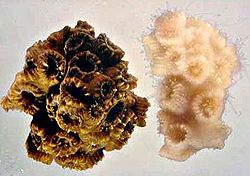
Unbleached and bleached coral
Coral reefs are the largest structures created by living organisms, and contain abundant and highly complex microbial communities. A coral "head" is a colony of genetically identical polyps, which secrete an exoskeleton near the base. Depending on the species, the exoskeleton may be hard, based on calcium carbonate, or soft and proteinaceous. Over many generations, the colony creates a large skeleton that is characteristic of the species. Diverse forms of life take up residence in a coral colony, includingphotosynthetic algae such as Symbiodinium, as well as a wide range of bacteria including nitrogen fixers,15 all" target="_blank" rel="noopener">of which form an important part of coral nutrition.[16 The association between coral and its microbiota is species dependent, and different bacterial populations are found in mucus, skeleton and tissue from the same coral fragment.17
Over the past several decades, major declines in coral populations have occurred. Climate change, water pollution and overfishing are three stress factors that have been described as leading to disease susceptibility. Over twenty different coral diseases have been described, but of these, only a handful have had their causative agents isolated and characterized.
Coral bleaching is the most serious of these diseases. In the Mediterranean Sea, the bleaching of Oculina patagonica was first described in 1994 and, through a rigorous application of Koch's Postulates, determined to be due to infection by Vibrio shiloi.18 From 1994 to 2002, bacterial bleaching ofO. patagonica occurred every summer in the eastern Mediterranean. Surprisingly, however, after 2003, O. patagonica in the eastern Mediterranean has been resistant to V. shiloi infection, although other diseases still cause bleaching.
The surprise stems from the knowledge that corals are long lived, with lifespans on the order of decades,do not have adaptive immune systems. Their innate immune systems do not produce antibodies, and they should seemingly not be able to respond to new challenges except over evolutionary time scales. Yet multiple researchers have documented variations in bleaching susceptibility that may be termed 'experience-mediated tolerance'.[20puzzle of how corals managed to acquire resistance to a specific pathogen led Eugene Rosenberg and Ilana Zilber-Rosenberg to propose the Coral Probiotic Hypothesis.[17 This hypothesis proposes that a dynamic relationship exists between corals and their symbiotic microbial communities. Beneficial mutations can arise and spread among the symbiotic microbes much faster than in the host corals. By altering its microbial composition, the "holobiont" can adapt to changing environmental conditions far more rapidly than by genetic mutation and selection in the host species alone.
Extrapolating the Coral Probiotic Hypothesis to other organisms, including higher plants and animals, led to the Rosenberg's support for and publications around the Hologenome Theory of Evolution.
댓글 0