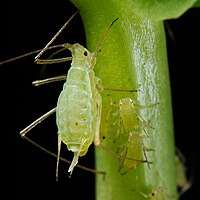
Pea aphids extracting sap from the stem and leaves of garden peas
The pea aphid Acyrthosiphon pisum maintains an obligate symbiotic relationship with the bacterium Buchnera aphidicola, which is transmitted maternally to the embryos that develop within the mother's ovarioles. Pea aphidslive on sap, which is rich in sugars but deficient in amino acids. They rely on their Buchnera endosymbiotic population for essential amino acids, supplying in exchange nutrients as well as a protected intracellular environment that allows Buchnera to grow and reproduce.relationship is actually more complicated than mutual nutrition; some strains of Buchnera increases host thermotolerance, while other strains do not. Both strains are present in field populations, suggesting that under some conditions, increased heat tolerance is advantageous to the host, while under other conditions, decreased heat tolerance but increased cold tolerance may be advantageous.[33 One can consider the variant Buchnera genomes as alleles for the larger hologenome.association between Buchnera and aphids began about 200 million years ago, with host and symbiont co-evolving since that time; in particular, it has been discovered that genome size in various Buchneraspecies has become extremely reduced, in some cases down to 450 kb, which is far smaller even than the 580 kb genome of Mycoplasma genitalium.[34
Development of mating preferences, i.e. sexual selection, is considered to be an early event in speciation. In 1989, Dodd reported mating preferences in Drosophila that were induced by diet.has recently been demonstrated that when otherwise identical populations of Drosophila were switched in diet between molasses medium and starch medium, that the "molasses flies" preferred to mate with other molasses flies, while the "starch flies" preferred to mate with other starch flies. This mating preference appeared after only one generation and was maintained for at least 37 generations. The origin of these differences were changes in the flies' populations of a particular bacterial symbiont, Lactobacillus plantarum. Antibiotic treatment abolished the induced mating preferences. It appears that the symbiotic bacteria changed the levels of cuticular hydrocarbon sex pheromones.[36
Zilber-Rosenberg and Rosenberg (2008) have tabulated many of the ways in which symbionts are transmitted and their contributions to the fitness of the holobiont, beginning with mitochondria found in all eukaryotes, chloroplast in plants, and then various associations described in specific systems. The microbial contributions to host fitness included provision of specific amino acids, growth at high temperatures, provision of nutritional needs from cellulose, nitrogen metabolism, recognition signals, more efficient food utilization, protection of eggs and embryos against metabolism, camouflage against predators, photosynthesis, breakdown of complex polymers, stimulation of the immune system, angiogenesis, vitamin synthesis, fiber breakdown, fat storage, supply of minerals from the soil, supply of organics, acceleration of mineralization, carbon cycling, and salt tolerance.37
댓글 0