Disclaimer: Not under BioLicense. CopyRight to Alan Kyungwhan An and Jong Bhak under CC-BY-NC-SA.
Geroelasticity as the Universal Theory of Aging (An & Bhak Biological Aging or "ABBA" Theory)
Refer to: https://en.wikipedia.org/wiki/ABBA
Pairs well with
Don't Shut Me Down (2021) by ABBA
“ut tensio, sic vis (as the extension, so the force)"
― Robert Hooke
Preface
Imagine your bodily condition like a rubber band: it stretches and snaps back (“Geroelasticity”),
but too much stress causes permanent damage (“Geroplasticity”). When we face illness or other
challenges, our bodies temporarily age faster yet often return to normal once recovered.
Introduction
Biological systems under stress experience both reversible and irreversible changes, akin to the elastic
and plastic behavior of physical materials. Aging can be understood through a stress-strain analogy.
Transient disturbances to homeostasis, such as infections, can induce temporary accelerations in
biological aging representing elastic deformation that can fully revert after recovery (“Geroelasticity”).
In this state, the system spontaneously returns to baseline once the stressor abates.
When cumulative or severe stress exceeds a critical threshold, the system transitions into a regime of
plastic deformation, where recovery to the original youthful state becomes incomplete or “almost”
impossible (“Geroplasticity”). Here, deviations in biological age persist even after the stressor is
removed.
The analogy extends further. Elastic hysteresis describes energetic loss incurred during repeated
loading-unloading cycles via entropic dissipation. We propose that excessive biological hysteresis
corresponds to stochastic molecular damage, including genetic, epigenetic, and proteomic drift, which
is manifested as the hallmarks of aging (Lopez-Otin et al., 2023). The energetic cost during hysteresis
provides the forward momentum of aging (Meyer & Schumacher, 2025). Indeed, the stochastic
information loss is a powerful predictor of biological age. Clocks based on entropy outperform
traditional mean-level models, achieving Pearson correlations >0.90 with chronological age using only
a few CpG loci demonstrating that information disorder is a principal driver of epigenomic aging (Chan
et al., 2025).
Geroelasticity quantifies the “elastic range” of aging biology, the domain within which biological age
accelerations remain reversible and energetic losses remain bounded. Gerostasis can be understood as
the operational state in which Geroelasticity is preserved. Conversely, Geroplasticity is the equivalent
of the “plastic range” of aging biology, and the subsequent Geroprogression ensues.
Physical stress, strain, and stiffness
In material sciences, elasticity refers to the ability of a material to return to its original shape after a
deforming force is removed, while plasticity describes permanent deformation that occurs when the
force exceeds elastic limit. Within the elastic regime, Hooke’s Law applies: force (i.e., stress) needed
to extend the material increases proportionally to displacement (i.e., strain). The proportionality
constant is Young’s modulus (E) or stiffness. The modulus of resilience (Ur) corresponds to the area
under the stress-strain curve up to the elastic limit (i.e., yield point). The stress at the yield point is the
yield point is the yield strength (Callister, 2018). Beyond the elastic limit, the material permanently
deforms, and the proportional law no longer satisfies. The maximal stress permitted prior to fracture
(breakage point) is referred to as ultimate strength. Toughness is the total area under the curve (Figure 1).
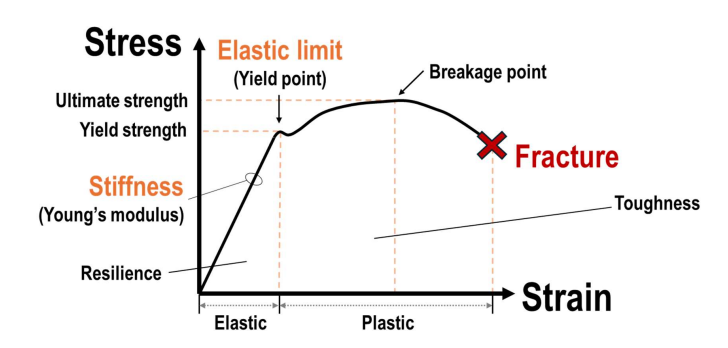
Figure 1. Stress-strain curve of a physical material.
Biological stress, strain, and tolerance
To formalize the relationship between biological deformation (strain) under perturbation (stress) and
inter-individual variation in withstanding the stress, we introduce the concept of effective (biological)
tolerance (keff), an analogue of physical stiffness in material science. In this framework, biological
systems experience stress (i.e., environmental and lifestyle exposures), strain (i.e., biological age
acceleration and physiological dysfunction), and tolerance (i.e., resistance to dysfunction). We posit that
biological tolerance is determined by two components: a genetic baseline tolerance (kgeno), reflecting
the inherited propensity to withstand physiological perturbation, and an epigenetic modulation factor
(βepi), which captures the interaction between genetic pre-determinants with the environment.
A schematic representation of this framework is shown in Figure 2, where keff is modeled as the
multiplicative interaction:
keff = kgeno × βepi.
Environmental or behavioral states, such as caloric restriction or excessive alcohol consumption, shift
and thus alter the apparent material “stiffness” of the biological system. We further hypothesize that
biological tolerance may correspond to lifespan potential in the view of comparative genomics (Figure 3).
The biology underlying that determines the tolerance could be shared across mammals.
The biology underlying that determines the tolerance could be shared across mammals.
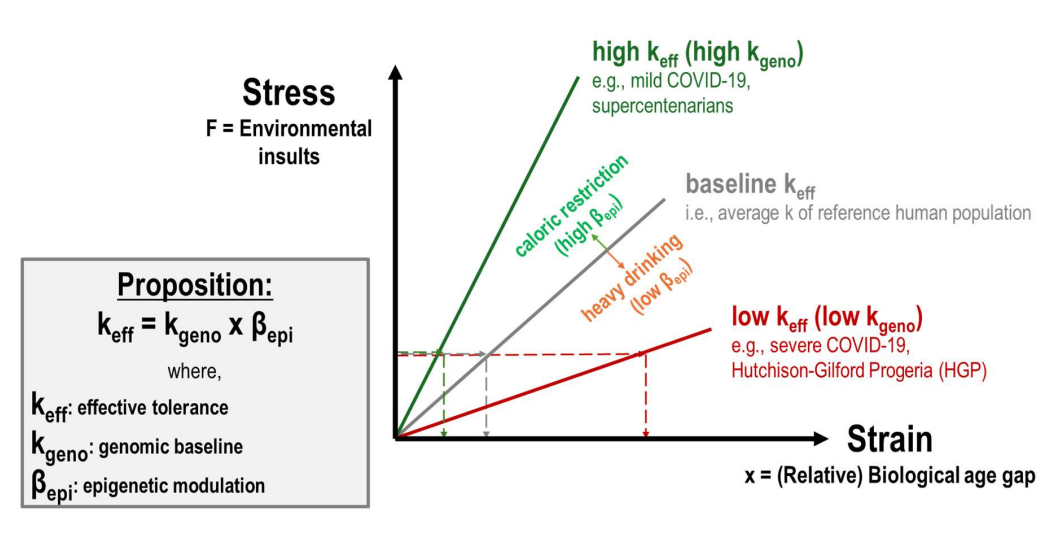
Figure 2. A simple model of effective tolerance shaped by genomic baseline and epigenetic modulation.
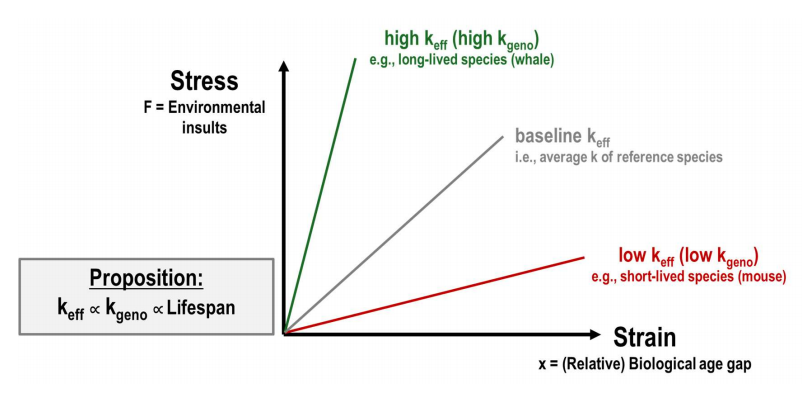
Figure 3. A simple model of effective tolerance possibly associated with lifespan.
댓글 0